Led by Qin Shi Huang, the Qin dynasty was a very well structured and systematically set up. Using the very orderly form of government known as legalism, it had strict laws and harsh penalties for those who broke them. Laws included one large set of rules that formed a code of conduct that guides the people in the empire on how they should act in society and with strict consequences it would be wise to adhere to them. Qin Shi Huang was the undivided ruler and controlled the empire similarly to a dictator. He had complete control only having few advisors to recommend what he should do. There were however small local government branches but they merely just handle disputes and dictate Qin Shi Huang's decrees. Qin Shi Huang divided the land into 36 prefectures that had one over-watcher with few other people involved.
Everyday life was drastically changed as legalism became the political structure, rather than the few laws and few punishments like Confucianism. This code of conduct made life more like life in the current United States where there are many laws but if you follow them and are a productive member of society then life is good. If however you a not you will be severely punished and disciplined. Since China was divided into 36 districts it was run more smoothly and citizens with legislative concerns or legal disputes could be handled faster. All in all the legalistic Qin dynasty was a very efficient change in political structure and it benefitted the overall outcome into modern China in epic proportions.
Friday, April 26, 2013

Thursday, April 25, 2013
Why Confucian Books Should Be Burned
By chief editor Matthew Hamer
The Qin dynasty was full of strides in all fields of the country in a mere fifteen years. The country obtained a common currency, a common language, massive engineering feat and a set of standard laws but some drastic change must occur to kickstart these interventions and that was the burning of pro Confucian literature and scripture. "Destroying literature and persecuting Confucians was an extension of the original plans to consolidate the Qin dynasty composed by Qin Shi Huang("Burning Of The Books", Paragraph One).Initiated by Qin Shi Huang the book burnings exposed of scripture that would further delay these feats and accomplishments but once these books were burned the Qin dynasty could focus on more beneficial accomplishments like a wall to protect against the Mongols. By refining and consolidating the empire to just legalists, Qin Shi Huang could eliminate opposing groups leaving less tension between the empire and now that Confucians were gone there were less radical ideas that could slow the advancements in empire.
These pro Confucian literature works preach to people that all that matters is following the moral code and by doing this they did not make any strides to help better the early Chinese dynasty in the fields of culture, economics or politics. "This is further complicated when 200 years after the death of Confucius, the Qin dynasty decides to suppress Confucianism and burn Confucius' books"("Confucianism", Paragraph Two). The book burnings however halted and disrupted the spread of Confucianism and they proved to set back the teachings of Confucianism and along with legislative action Confucianism's parasitic concepts slowed the advancement of Legalism excelled. Once destroyed and expelled the new legalist polices helped mold China into a more efficient empire that began a short but prosperous period. It is for these previously listed reasons that I encourage the destruction of pro Confucius materials.
The Qin dynasty was full of strides in all fields of the country in a mere fifteen years. The country obtained a common currency, a common language, massive engineering feat and a set of standard laws but some drastic change must occur to kickstart these interventions and that was the burning of pro Confucian literature and scripture. "Destroying literature and persecuting Confucians was an extension of the original plans to consolidate the Qin dynasty composed by Qin Shi Huang("Burning Of The Books", Paragraph One).Initiated by Qin Shi Huang the book burnings exposed of scripture that would further delay these feats and accomplishments but once these books were burned the Qin dynasty could focus on more beneficial accomplishments like a wall to protect against the Mongols. By refining and consolidating the empire to just legalists, Qin Shi Huang could eliminate opposing groups leaving less tension between the empire and now that Confucians were gone there were less radical ideas that could slow the advancements in empire.
These pro Confucian literature works preach to people that all that matters is following the moral code and by doing this they did not make any strides to help better the early Chinese dynasty in the fields of culture, economics or politics. "This is further complicated when 200 years after the death of Confucius, the Qin dynasty decides to suppress Confucianism and burn Confucius' books"("Confucianism", Paragraph Two). The book burnings however halted and disrupted the spread of Confucianism and they proved to set back the teachings of Confucianism and along with legislative action Confucianism's parasitic concepts slowed the advancement of Legalism excelled. Once destroyed and expelled the new legalist polices helped mold China into a more efficient empire that began a short but prosperous period. It is for these previously listed reasons that I encourage the destruction of pro Confucius materials.
Works Cited
Text Citations
"Confucianism".TotallyHistory.com. 2012. Totally History. 21 April 2013.http://totallyhistory.com/confucianism-during-the-han-dynasty/.
"The Burning Of The Books".www.thenagain.info. 1999. WebChron. 20 April 2013. http://www.thenagain.info/webchron/china/bookburn.html.
Image Citations
Pictures And Photos Of The Terra Cotta Warriors. http://www.terracotta-warriors.com/index.php?act=viewDoc&docId.
Terra Cotta Warriors. http://www.destination360.com/asia/china/terra-cotta-warriors.
The Qin Dynasty Circa 210 bc. http://en.wikipedia.org/wiki/Qin_dynasty.
"Confucianism".TotallyHistory.com. 2012. Totally History. 21 April 2013.http://totallyhistory.com/confucianism-during-the-han-dynasty/.
“Terracotta Warriors”.www.globalmountainsummit.org 2011. Global Mountain Summit. 22 April 2013. http://www.globalmountainsummit.org/terra-cotta-warriors.html.
“Qin Dynasty”. en.wikipedia.org.24 April, 2013. Wikipedia Foundation. 25 April 2013. http://en.wikipedia.org/wiki/Qin_Dynasty.
"The Burning Of The Books".www.thenagain.info. 1999. WebChron. 20 April 2013. http://www.thenagain.info/webchron/china/bookburn.html.
Image Citations
Pictures And Photos Of The Terra Cotta Warriors. http://www.terracotta-warriors.com/index.php?act=viewDoc&docId.
Terra Cotta Warriors. http://www.destination360.com/asia/china/terra-cotta-warriors.
The Qin Dynasty Circa 210 bc. http://en.wikipedia.org/wiki/Qin_dynasty.
The Map of The Qin Dynasty

This map depicts the Qin dynasty and some of the major features of its time period. The black dotted line representsthe Great Wall of China and as you can see on the map it is located on the northand northwest boundaries of China in the Qin dynasty. The capitol representedby the large red dot is signified as Qin. The multitude of smaller red dotsrepresents the cities and most of them are centralized to china proper. The tanland represents land not then owned by the Chinese and this mostly occurs awayfrom the coast with Pacific Ocean with the exception of the lower south easternportion of the continent near the border of modern day India and China. Theygrey lines that are seen frequently running through the terrain representrivers and in China proper where they are situated there is an abundance ofthem flowing throughout. The dark blue indicates the shorelines whereas thelighter blue indicates the deeper waters in the pacific ocean.
Qin Dynasty's Culture
By chief editor Matthew Hamer
In the Qin dynasty culture was expressed in different forms than that of other Chinese dynasties because the entire country became legalists. Which meant that rather than expressing culture through very whimsical artwork, their artwork and literature became more civil and they did not speak of radical concepts like that of other Chinese religions or code of conducts. In the Qin dynasty the arts included sculpting and most famously the terra cotta warriors or the warriors of the afterlife. These sculptures depict Chinese soldiers meant to guard their leaders in the afterlife and at one site archeologists discovered hundreds of them all guarding their beloved ruler Qin Shi Huang .These intricately crafted life sized warriors were all unique and no two are the exact same. Historians speculate that it took 10 years for sculptures to create an army of clay in such proportions. One disadvantage is that since the Qin dynasty was around so long ago most artifacts were destroyed leaving historians little to analyze but only to speculate at the vast cultural wonders that made up the Qin dynasty.
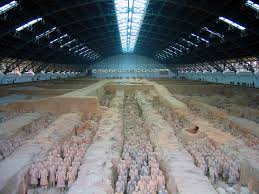
(This image above shows the uncovered terra cotta
soldiers from the Qin dynasty)
In the Qin dynasty culture was expressed in different forms than that of other Chinese dynasties because the entire country became legalists. Which meant that rather than expressing culture through very whimsical artwork, their artwork and literature became more civil and they did not speak of radical concepts like that of other Chinese religions or code of conducts. In the Qin dynasty the arts included sculpting and most famously the terra cotta warriors or the warriors of the afterlife. These sculptures depict Chinese soldiers meant to guard their leaders in the afterlife and at one site archeologists discovered hundreds of them all guarding their beloved ruler Qin Shi Huang .These intricately crafted life sized warriors were all unique and no two are the exact same. Historians speculate that it took 10 years for sculptures to create an army of clay in such proportions. One disadvantage is that since the Qin dynasty was around so long ago most artifacts were destroyed leaving historians little to analyze but only to speculate at the vast cultural wonders that made up the Qin dynasty.
(This image above shows the uncovered terra cotta
soldiers from the Qin dynasty)
(The image below portrays a closer view of the terra cotta warriors
In their discovery site)

The Warring States end and the Qin dynasty begins
By chief editor Matthew Hamer
In 221 b.c. Qin Shihuang ended the warring states period, when his forces in Qin state eventually conquered all other states. Upon conquering the other states, Qin Shihuang pronounced himself emperor of China. Shihuang officially started Qin dynasty, a period of standardization. Although it only lasted 15 years it carved its mark in China's history. The end of the struggle between the six states marks an important time in Chinese history, because after this time Qin Shihuang began to make China a more standardized place. The standardization began with one common language shared by all of China, this change is important because then trade expanded because it became easier to communicate. China's country became more advanced with a common language so larger engineering feats became easier like the Great Wall of China. Eventually Shihuang began to standardize monetary values into one set of currency, and now trade became even more easier and trade flourished. Shihuang also implemented legalistic policies that made government more efficient by setting guidelines that allowed the government to refer to the laws for easier dictation of the law. Just as the Qin dynasty was strengthening China, Qin Shihuang died and then leadership changed. Qin Er Shi took power and then China began decline in 210 b.c.
In 221 b.c. Qin Shihuang ended the warring states period, when his forces in Qin state eventually conquered all other states. Upon conquering the other states, Qin Shihuang pronounced himself emperor of China. Shihuang officially started Qin dynasty, a period of standardization. Although it only lasted 15 years it carved its mark in China's history. The end of the struggle between the six states marks an important time in Chinese history, because after this time Qin Shihuang began to make China a more standardized place. The standardization began with one common language shared by all of China, this change is important because then trade expanded because it became easier to communicate. China's country became more advanced with a common language so larger engineering feats became easier like the Great Wall of China. Eventually Shihuang began to standardize monetary values into one set of currency, and now trade became even more easier and trade flourished. Shihuang also implemented legalistic policies that made government more efficient by setting guidelines that allowed the government to refer to the laws for easier dictation of the law. Just as the Qin dynasty was strengthening China, Qin Shihuang died and then leadership changed. Qin Er Shi took power and then China began decline in 210 b.c.
Subscribe to:
Posts (Atom)